Straight answers
Ceramic Coating Questions, Answered by Isaac
Honest answers to the questions people ask before buying a ceramic coating on the Sunshine Coast, from someone who has coated more than 100 vehicles. No sales pitch, including when a coating isn't worth it.
Ask Isaac: 0468 075 012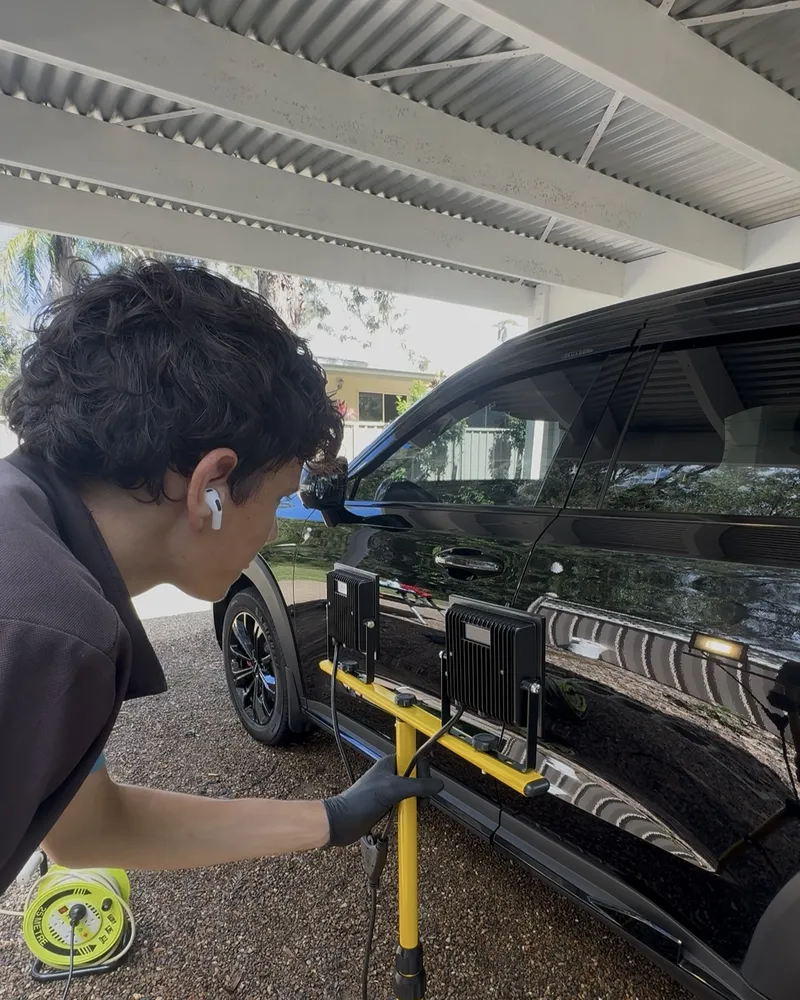
Is ceramic coating worth it?
Yes, for the right person. The right person washes their car at least once a month. A coating makes washing and drying quicker and more enjoyable, means you need less harsh cleaner to get bugs off the bumper, headlights, wheels, trim and mirrors, and reduces wash swirls because the slicker surface cuts friction. It also means the car can be blow-dried. Without a coating, water just puddles and doesn't roll off.
Uncoated cars also collect more contaminants in the paint. That's the rough, gritty texture you feel on an older car, and left long enough it leads to oxidation. A coating seals the clear coat so the clear coat can keep doing its job of protecting the base coat.
Who shouldn't get a ceramic coating?
I'll talk you out of a coating if you plan to sell the car soon, if the clear coat is badly oxidised, flaking or peeling, if you don't like washing your car and don't have the budget for maintenance, or if you use automatic or brush car washes.
Brush washes swirl a finish after a single wash, even when the brushes are clean. Touchless automatic washes use highly caustic chemicals, because they're built to clean unprotected daily drivers without touching them. Either one will undo hours of paint correction. For cars with oxidised or peeling clear coat, I always tell the owner the oxidation will come back.
Ceramic coating vs wax vs sealant vs PPF: what's the difference?
A coating is a cleaning aid. It seals the clear coat so dirt, bug guts and bird droppings come off easily, and with regular washing it keeps a car looking like new. It won't stop rock chips, scratches, sand or other physical abrasion.
Wax is the old-school, hand-applied option. It still has its place on oxidised cars, show cars and daily drivers whose owners enjoy applying it often, and it gives a warmth and depth of gloss some coatings can't match. Its chemical resistance, heat resistance and water behaviour are well below a coating's. A sealant is the modern version of wax, usually sprayed on and wiped off, or a wet-applied product like Gyeon WetCoat. Water behaviour is decent and it's low effort. PPF is the most durable if abrasion, rock chips and swirls are your concern, and many films self-heal swirls with heat. The catches: some films yellow, and a film left on too long can damage the paint when it comes off.
Why does one detailer charge $500 and another $2,000?
It comes down to the job. At $500 you're lucky if the car is even decontaminated before the coating goes on. Take out tax and GST, which I estimate at roughly 40% of the price, and the operator has about $300. A decent bottle of coating costs at least $150, which leaves about $150 for labour and running costs.
To stay profitable, that detailer can spend about an hour and a half on your car. We usually spend a full day on a coating job, and several days on a major correction. At $500 you're getting about a tenth of the job, or not a real coating at all. It makes more sense to get it done right the first time and save yourself the time, effort and damage an inexperienced detailer can cause.
Are $30 ceramic coatings from eBay any good?
The cheapest coatings I've seen are the $30 bottles customers buy from eBay or online stores. I've tested some of them, and they behave like a spray sealant poured into a small bottle. They give a few weeks of protection at best.
If you're going to the effort of decontaminating and correcting a car, use a quality coating, or you've wasted your time. Within six months a cheap product wears off, contamination builds up again, and bug guts and road grime need extra chemicals to remove.
Should I apply a ceramic coating myself?
There are decent consumer options, like Gyeon CanCoat and some trim and leather coatings. They're forgiving, so a poorly levelled patch isn't a disaster. Pro coatings contain far more solids, so they go on thicker and take several towels of different weights to level properly.
The DIY mistakes I see most: skipping the IPA wipe before coating, cutting the paint without a refining polish so it's left hazy, and not wiping the coating off properly so high spots appear.
Which car paints are hardest and softest to work on?
The hardest clear coat I've worked on is a BMW X5. German clear coats take a lot of correction power to remove swirls, but the trade-off is that they resist wash swirls. The hardest to finish down is black Tesla paint. It's very soft and scratches easily from microfibres, applicators and clay bars.
Most new vehicles have thin paint now, some with orange peel texture, especially new Chinese brands like Chery, LDV, Geely and GWM, and Japanese brands like Mitsubishi and especially Subaru. The Pajero Sport is a common one I see. Many modern Japanese, Chinese and some European cars use water-based clear coats, and solid flat colours on them are soft: easy to correct, but easy to scratch. Even a plush towel can mar them.
How do you choose the right paint correction?
It depends on what the customer wants, but I start by assessing what the paint needs. On a soft clear coat I might use a medium-firmness foam pad with a finishing polish like KCX Micro Cut or CarPro Reflect.
On a hard car like a BMW X5 I might start with a wool pad on a rotary with Sonax Perfect Cut or KCX Heavy Cut H9, move to a microfibre pad on a dual action polisher with CarPro Fixer or 3D One, and finish with an orange foam pad and a finishing polish like CarPro Reflect or Micro Cut.
What do you coat as standard?
On every coating job I try to coat as much surface as possible. Wheel faces, trims, wheel arches, door jambs and glass are coated as standard, not as add-ons.
Every car should get full protection as standard, so there's no add-on menu to work through.
What is a ceramic coating high spot and how do I check for one?
A high spot is coating that wasn't levelled before it cured. It usually shows as a darker patch on the paint, and can look oily or rainbow-coloured. Check under indirect light, not direct sun.
I've had a near miss myself: once my applicator was over-saturated and the coating started flashing quickly. If I hadn't had the right levelling cloths on hand, it would have left a high spot that needed polishing or sanding out. That's why I keep plenty of fresh towels within reach on every job.
Can you ceramic coat in Sunshine Coast humidity?
Yes, with preparation. On a humid day I keep plenty of fresh towels on hand and level each panel straight away, because pro coatings start to flash almost instantly in humidity.
Coatings work year-round here. In summer a coating helps the clear coat cope with strong UV, and our winters don't get cold enough to change how a coating performs.
How should I clean my car after beach driving at Teewah or Bribie?
An underbody wash is essential after beach driving. Salt water builds up on the paint and can etch it.
Pre-wash the car first so loose sand isn't dragged across the paint and swirling it. Then do a proper contact wash.
Does tank, town or bore water matter for washing?
Yes. Tank water is sometimes cleaner, with fewer minerals, than town or bore water. Town and bore water can carry a lot of minerals that leave water spots.
Left long enough, those spots etch permanently into the clear coat. Dry the car properly after every wash, whatever water you use.
Will a ceramic coating last on a car parked outside?
A black car parked in an open car park for a year will be fine if it's coated, hand washed regularly, and parked away from trees and birds. Out in the elements, contaminants bake in about ten times quicker.
A coating on a garaged car lasts longer than one outside, partly because garaged cars usually get washed more often and looked after better. Even without a garage, you can get a good life out of a coating.
What's the worst thing you can do to a new ceramic coating?
Spend the money on a correction and coating, then take the car through a drive-through car wash.
Brushes swirl the paint even when they're clean, and touchless washes rely on harsh chemicals. Either one undoes hours of paint correction.
What happens at the yearly coating inspection?
The yearly inspection includes an acid wash that removes contaminants clogging the coating.
After it, the coating gets back the water behaviour it sometimes loses when it's clogged.
How do I know my ceramic coating is failing?
Watch the water. The first sign is losing those tight, round water beads. Next the beads get bigger, less round and more teardrop-shaped. Then they flatten and the water starts sheeting.
Eventually the water doesn't react to the paint at all and just sits flat. At that point the coating has fully failed, and an acid wash won't revive it.
Real reviews
What customers say
Isaac spent 9 hrs on my car and gave back to me better than the Dealers handover. I would never get Dealers ever to Coat any car. Any new car buyer I full recommend Isaac's Car Detailing.
Isaac did an amazing job on my ranger raptor, very easy to work with from start to finish, and very happy with the ceramic coating done, he even did the door jambs and interior. Gave me instructions to look after car going forward.
Car came up looking great! Spent the time to explain how to care for the coating afterwards and how to wash it going forward. Would 100% recommend.
Still have a question?
Call Isaac. He'll give you a straight answer, even if it's that you don't need a coating.